


 Español
 Deutsch
 Français
 Nederlands
 Polski
 Русский
 Українська
 Norsk
 Svenska
 Suomi
 Italiano
 Dansk
 Čeština
 Português
 Română
 Български
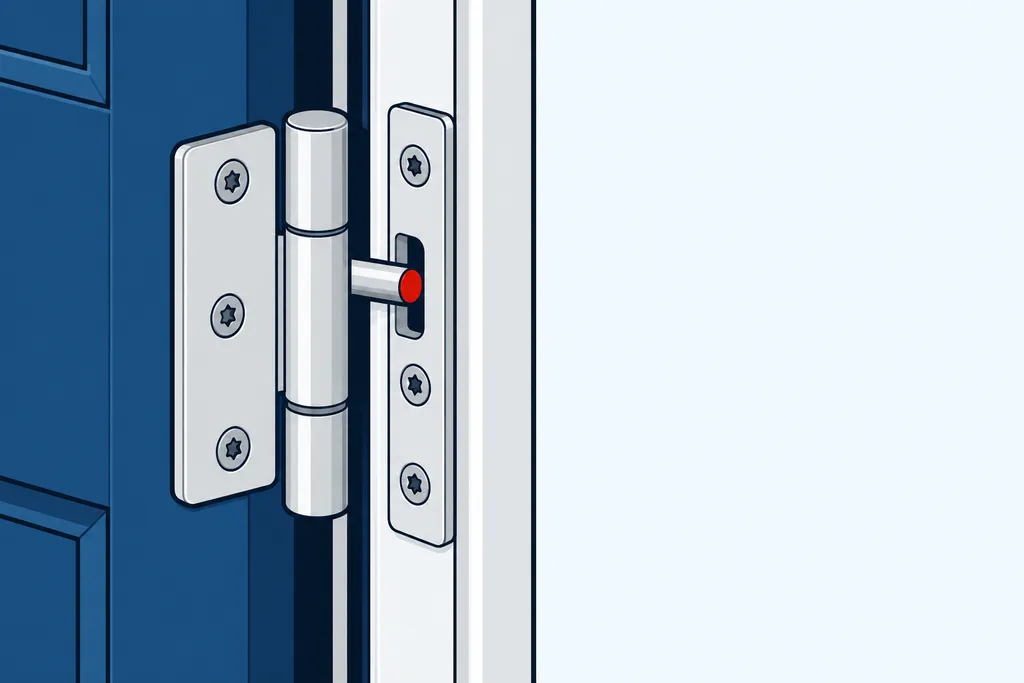
A door is held to its frame on two sides: the lock side and the hinge side. When someone wants to get in without a key and finds the lock well protected, they look at the other side. If the hinges are ordinary ones, they can try to lever between the leaf and the frame on that side or, on doors that open outwards, knock out the hinge pins or cut them. Anti-jemmy hinges exist so that none of that works.
What exactly they are
By anti-jemmy hinges we mean two things that are often combined:
Hinge bolts
These are steel pins screwed into the edge of the leaf, on the hinge side. When the door closes, they go into reinforced holes in the frame. That way, even if someone cut the hinges or ripped them off, the door would still be held to the frame on that side. They cannot be seen with the door shut and they do not affect everyday use.
Security hinges
These are sturdier hinges, with the pin protected or fixed so that it cannot be removed from outside, and with more and longer screws. Some have an internal pin that does the same job as a hinge bolt. On security doors, these hinges usually come as standard and are heavy duty pivot hinges.
When they are worth it
Anti-jemmy hinges make a lot of sense on these doors:
- Doors that open outwards. This is the clearest case, because the hinges are exposed on the outside face. It happens with many storerooms, meter rooms, patio doors and some bungalow doors.
- Ground floor front doors with direct access from the street or from an unwatched garden.
- Second homes that stay empty for weeks or months, where nobody hears or sees what goes on at the door.
- Shops and warehouses with timber or metal doors onto the street.
- Doors that already have a good lock and escutcheon, so the hinge side is not left as the weak point.
How to tell if your door is exposed
Do this simple check:
- Look from outside to see whether the hinges are visible. If they are, it is a door that opens outwards and has its hinge pins within reach.
- With the door shut, look at the gap on the hinge side. If the tip of a screwdriver fits, a crowbar fits.
- Open the door and look at how many screws each hinge has and whether they are short. Short screws in a softwood frame pull out easily.
If you find any of these three things, send us photos and we will tell you what is best.
What they do not fix
Anti-jemmy hinges protect one particular side of the door. They are not much use if the leaf is hollow and can be smashed through, or if the frame is loose in the wall. In those cases, before hinges, what is needed is door reinforcement or frame reinforcement. Nor do they replace a good lock: they are the piece that completes the set.
How it fits with the rest of the protection
A secure door is a balance. If you heavily reinforce one side and leave the other weak, whoever tries to get in goes for the weak one. That is why we usually check the whole door: the cylinder, the escutcheon, the lock, the hinges and the frame. That full check is what we do in a home security upgrade, and anti-jemmy hinges are one of the most forgotten pieces.
In homes that are left empty, the hinge side is one of the things we check as part of squatter protection, along with the roller shutters and the secondary entrances.
Details we take care of
- The keeps in the frame are reinforced with a steel plate. A plain hole in timber breaks with the first push of a crowbar.
- Alignment. If the hinge bolts do not go in cleanly, the door rubs and ends up dropping. We adjust the leaf until it closes cleanly.
- Salt air. On the coast we choose finishes that stand up to salty damp, especially on outside doors.
- The weight of the door. If we change hinges, we fit ones suited to the weight of the leaf so it does not drop over time.
How we work
The quickest way is to send us WhatsApp photos of the hinge side, from inside and outside. With that we give you a fixed quote before we start. We cover Torrevieja and all of the Vega Baja, every day.