


 Español
 Deutsch
 Français
 Nederlands
 Polski
 Русский
 Українська
 Norsk
 Svenska
 Suomi
 Italiano
 Dansk
 Čeština
 Português
 Română
 Български
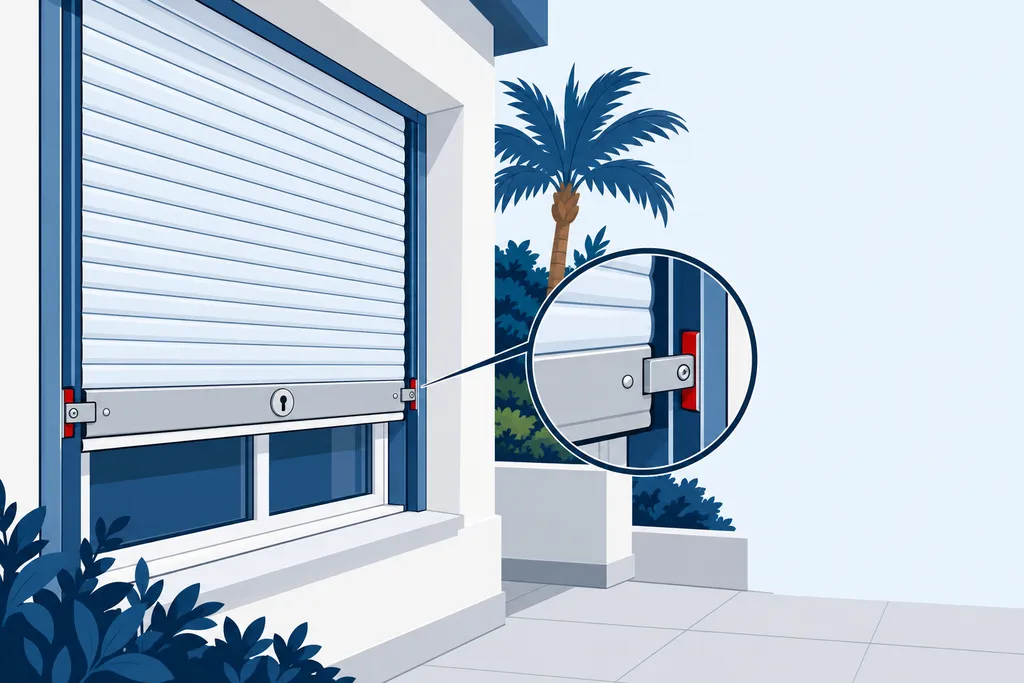
In Torrevieja and right across the Vega Baja there are a great many homes with windows within arm’s reach: bungalows, ground-floor flats with a garden, townhouses on urbanisations, single-storey houses. In many of them, when the shutter is down, it is the only thing between the street and the living room. And an ordinary roller shutter is made to give shade and keep the heat out, not to hold out against someone who wants to get in.
How they get in through a shutter
It hardly ever takes breaking anything dramatic. Whoever wants to get in looks for the last slat, the bottom one, which is the only one that can be gripped from outside. There are two usual ways of attacking it:
- Lifting it. Something is pushed in underneath, it is levered up and the shutter rises along its guide rails far enough to slip through or to reach the window.
- Bending it. The slat is pushed in the middle until it bows and comes out of the guide rails. Through that gap they can then work at leisure.
A shutter slat is a long, thin strip. If you push it in the middle, it gives. If you pull it from below, it rises. That is its weak point, and that is exactly where we work.
It happens above all where nobody is looking: windows onto a back patio, a terrace hidden behind a hedge or a quiet communal area. And it happens more in homes that are left empty for part of the year, because it can be tried without any hurry and nobody notices until weeks later.
Our solution: the T-profile reinforcement
It is Cerrajero Torrevieja’s own system. It has two parts, and both go on the bottom slat:
- A T-shaped steel profile of 4 mm, glued and screwed under the bottom slat of the shutter.
- Bolts at both ends of the slat, which slot into the wall.
Because of its shape, a T does not bend to one side or the other. Since it is fixed to the slat, that slat can no longer bend. And as both ends are slotted into the wall, there is nowhere to lift it from either. With the slat rigid and anchored at both sides, the shutter becomes very hard to open from outside: it cannot be bent, lifted or pulled out.
We sum it up in one sentence because it is exactly what it does: we reinforce roller shutters so they cannot be lifted or bent.
If you want to understand the idea piece by piece, and see what happens when someone tries to force a shutter with and without the reinforcement, it is explained in how the T-profile reinforcement works.
How it differs from what is already on sale
If you look up how to stop your shutter being lifted, you will mostly find anti-lift locks and shutter blockers. They are well-known products, many homes have them and each one does its job. The difference with the T-profile reinforcement lies in two points:
- Where the shutter is held. Most of those systems hold it at one point, often in the centre, or wedge it against the floor or the windowsill. The T-profile reinforcement anchors it at both ends, against the wall.
- What happens to the bottom slat. If the slat is still the same as always, it can bend even when it is held at one point. With the T-profile fixed to it, it no longer bends.
Each system reinforces a different part of the shutter. Ours reinforces the slat and its two ends, which is where the attack usually comes. It is compared calmly, type by type, in T-profile reinforcement versus locks and blockers.
Which homes it is designed for
Ground-floor flats, bungalows and townhouses
On a ground floor the windows can be reached from the ground, without a ladder. In summer many people sleep with the window open and the shutter down to let the air through, and at that moment the shutter is the only barrier left. We go into more detail in shutter security for ground-floor homes and bungalows.
Houses that stay empty for months
On the coast there are many holiday homes and many owners who live abroad for a good part of the year. A house closed up with the shutters down is a house where someone can work without anyone getting in the way. For those cases there is the page on shutter security for holiday homes. If what worries you is squatters, the shutter is one part of the problem and the door is the other: also see squatter protection.
Offices and premises with a window onto the street
Offices, surgeries and street-level premises that are left empty at night and at weekends also have roller shutters on their windows, and the problem is the same as in a home.
Which windows to reinforce first
If you are not going to reinforce them all at once, start with those most at risk:
- Those that cannot be seen from the street or from the houses opposite: back patios, the sides of the house, terraces enclosed by a hedge.
- Ground-floor windows that can be reached standing up, without climbing on anything.
- Those in the rooms that spend most time empty, such as a guest room or a living room that is not used in winter.
With the photos we tell you what we see, and you decide.
Can your shutter be reinforced?
Not all shutters or windows are the same, so we are not going to say yes without having seen it. The quickest way is to send us photos on WhatsApp:
- The whole shutter lowered, seen from outside.
- The bottom part, where the last slat rests on the windowsill or the floor.
- Both sides, where the shutter meets the wall.
With that we tell you whether your shutter can be reinforced and, if it can, we give you a fixed quote before we start. If when we arrive we see something different from what could be seen in the photos, we explain it to you and do not carry on unless you agree. You can pay by card, Bizum or cash.
Message us on WhatsApp in your language. We are Torrevieja locksmiths, born and bred, with 15 years of experience, and we work in Torrevieja and right across the Vega Baja.