


 Español
 Deutsch
 Français
 Nederlands
 Polski
 Русский
 Українська
 Norsk
 Svenska
 Suomi
 Italiano
 Dansk
 Čeština
 Português
 Română
 Български
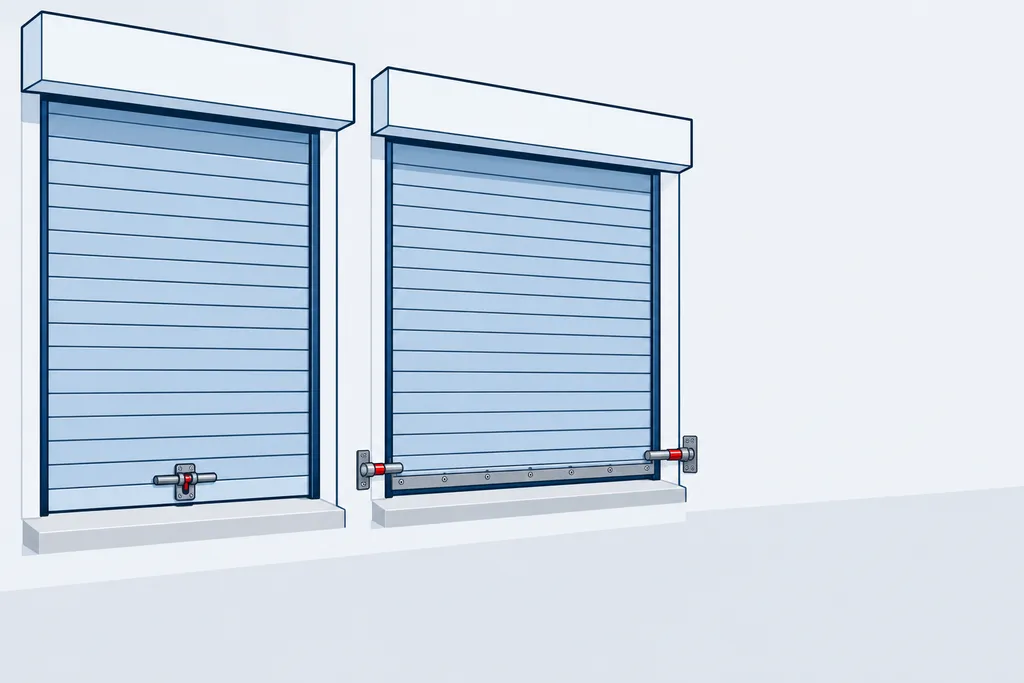
If you have looked up how to stop your shutter being lifted, you will have seen that there are many solutions on sale. They are all well-known products and they all have their place. We are not going to tell you that one is bad; we are going to explain how each one works so that you understand what you are buying.
Two very simple questions are enough to compare them:
- Where does it hold the shutter? At one point, against the floor, at the sides.
- What happens to the bottom slat? If it is still the same old slat, it can bend even when it is held.
What is on the market
Automatic anti-lift lock
This is a part that is fixed to the bottom slat and locks the shutter when you lower it, without you having to do anything. Its big advantage is convenience: you do not have to remember to lock it. What you need to bear in mind is that everything depends on that part and on the slat it is fixed to holding firm. If the slat bends, the hold loses strength.
Floor or windowsill lock
This is a bolt that runs from the bottom slat into the floor or the windowsill, sometimes with a clamp. It is simple and easy to understand at first sight. It needs an action every time: you have to bend down to lock it when you lower the shutter and to release it when you raise it. And it holds at one point, so the sides of the slat are the same as always.
Central bar lock
A bar that runs along the slat with bolts towards the sides. It spreads the hold better than a single point. What is worth checking is what it is mounted on, because it is usually fitted on uPVC or thin aluminium slats, which are still the original ones.
Clamp lock, no drilling
These are plates that grip the slat without making holes. They go on and come off easily, which makes them practical for anyone who does not want to alter anything. On the other hand, when someone really levers, they hold less than a screwed system.
Replacing the whole shutter with a security shutter
There is also the option of removing the shutter and fitting another one made to resist more. Everything is new, but it is a bigger job: the whole shutter is replaced.
The T-profile reinforcement
Our system works differently. Under the bottom slat of your shutter a 4 mm T-shaped steel profile is glued and screwed. Because of its shape, the T does not bend to one side or the other, so that slat stops bending. At both ends of the slat there are bolts that slot into the wall.
With those two questions from the start:
- It holds at both ends, against the wall, and not at a central point or against the floor.
- The bottom slat is no longer the same old one: it has a steel profile fixed to it that does not bend.
And it is fitted on the shutter you already have, without replacing it with another.
The comparison at a glance
| System | Where it holds | The bottom slat |
|---|---|---|
| Automatic anti-lift lock | At the part fixed to the slat | The original |
| Floor or windowsill lock | At one point, against the floor | The original |
| Central bar lock | At the bolts of the bar | The original |
| Clamp lock | At the plates that grip it | The original |
| New security shutter | Depends on the model | New |
| T-profile reinforcement | At both ends, against the wall | Reinforced with a T-shaped steel profile |
How to choose what suits you
There is no single answer for every house. Think about your own case:
- Does the house stand empty for long spells? Then the shutter has to hold out on its own, with nobody to react, and what counts most is how hard it is to bend or lift.
- Can the window be seen from the street? Those that cannot be seen are the ones that give most time to anyone who wants to get in.
- Who is going to use the lock every day? If you have to bend down every time, it may end up not being locked.
- Do you want to keep your shutter? If it is in good condition, there is no need to replace it to reinforce it.
If you already have a lock fitted and you are wondering whether the reinforcement is right for you, send us a photo of how it looks on WhatsApp and we will tell you what we see, with no obligation and with a fixed quote if you decide to go ahead.
The piece-by-piece explanation of the system is in how the T-profile reinforcement works, and the overview in shutter security.