


 Español
 Deutsch
 Français
 Nederlands
 Polski
 Русский
 Українська
 Norsk
 Svenska
 Suomi
 Italiano
 Dansk
 Čeština
 Português
 Română
 Български
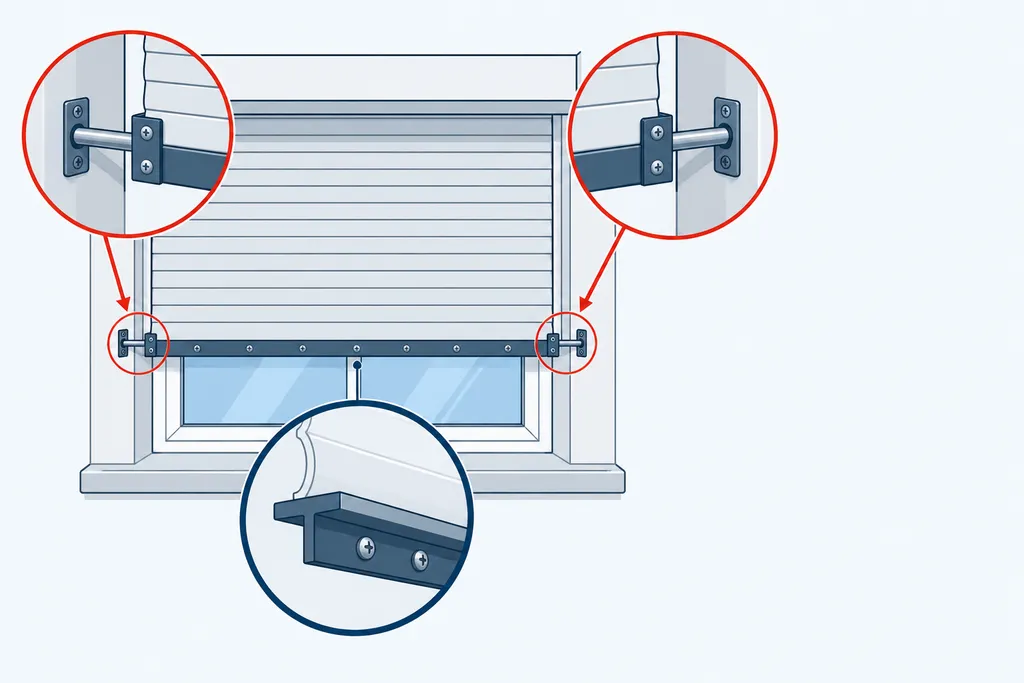
There are no secrets or strange words here. The T-profile reinforcement can be understood with three pieces and one very simple idea: if the bottom slat cannot bend and it is held to the wall at both sides, the shutter has no way of opening.
The three pieces
The bottom slat
Every roller shutter ends in a bottom slat, the one that rests on the windowsill or the floor when the shutter is down. From outside it is the only one that can be gripped, and that is why it is the one that gets attacked. The reinforcement does not swap your shutter for another one: it works on that slat.
The 4 mm T-shaped steel profile
It goes under the bottom slat, glued and screwed to it. The two kinds of fixing go together so that slat and profile work as if they were a single piece. From then on, whatever the slat does, the steel profile has to do as well, and the profile will not let itself be bent.
The bolts at the ends
At each of the two ends of the slat there is a bolt that slots into the wall. These are what stop the shutter from rising: even if someone pushes up from below, the slat is held at both sides to something that does not move.
Why a T in particular
Pick up a metal ruler. If you hold it on its edge and push, it is very hard to bend. If you lay it flat, it bends with two fingers. A flat piece always has an easy side.
The T brings both positions together in a single piece: one flat part and one on edge, at right angles. Whichever way you push, one of the two parts is always working on edge and holding firm. Because of its shape, a T does not bend to one side or the other. It is the same idea behind the use of profiles with this shape in construction when a piece must not give.
Fixed to the slat, that rigidity passes to the shutter. The slat stops being a thin strip that bows and becomes a bar that does not give.
What happens when someone tries to force it
A shutter without reinforcement
A lever is pushed in under the bottom slat. The slat, which is thin, bows in the middle. With the bow a gap opens up, the shutter rises a little along its guide rails or the slat comes out of them, and from there they keep pulling until they reach the window.
A shutter with T-profile reinforcement
The lever meets the steel profile. The slat does not bow, because the T does not allow it. If someone tries to lift the shutter, the bolts slotted into the wall hold it at both ends and it does not rise. If someone tries to bend it in the middle to pull it out of the guide rails, it does not give either, neither inwards nor outwards.
The result is a shutter that is very hard to open from outside. It cannot be bent, lifted or pulled out. That is what we mean by the sentence we always use: we reinforce roller shutters so they cannot be lifted or bent.
What the reinforcement does not do
It is worth saying clearly so that nobody gets the wrong idea. The T-profile reinforcement strengthens the shutter. The front door, the patio door or the cylinder remain as they were. If you want to check the whole house and not just the windows, there is the home security upgrade service, where we look at the whole property and tell you where it is easiest to get in.
Nor are we going to tell you that it works on any shutter without having seen it. Every window is different: the opening, the wall, the condition of the guide rails and of the shutter itself.
Before anything else, a photo
To find out whether your shutter can be reinforced, send us on WhatsApp a photo of the lowered shutter, seen from outside, and another of the sides, where it meets the wall. We reply with what we see and, if it can be done, with a fixed quote before we start.
If you are weighing this up against an anti-lift lock, the differences are explained in the comparison with locks and blockers. And if you want to go back to the overview, you have it on the shutter security page.