


 Español
 Deutsch
 Français
 Nederlands
 Polski
 Русский
 Українська
 Norsk
 Svenska
 Suomi
 Italiano
 Dansk
 Čeština
 Português
 Română
 Български
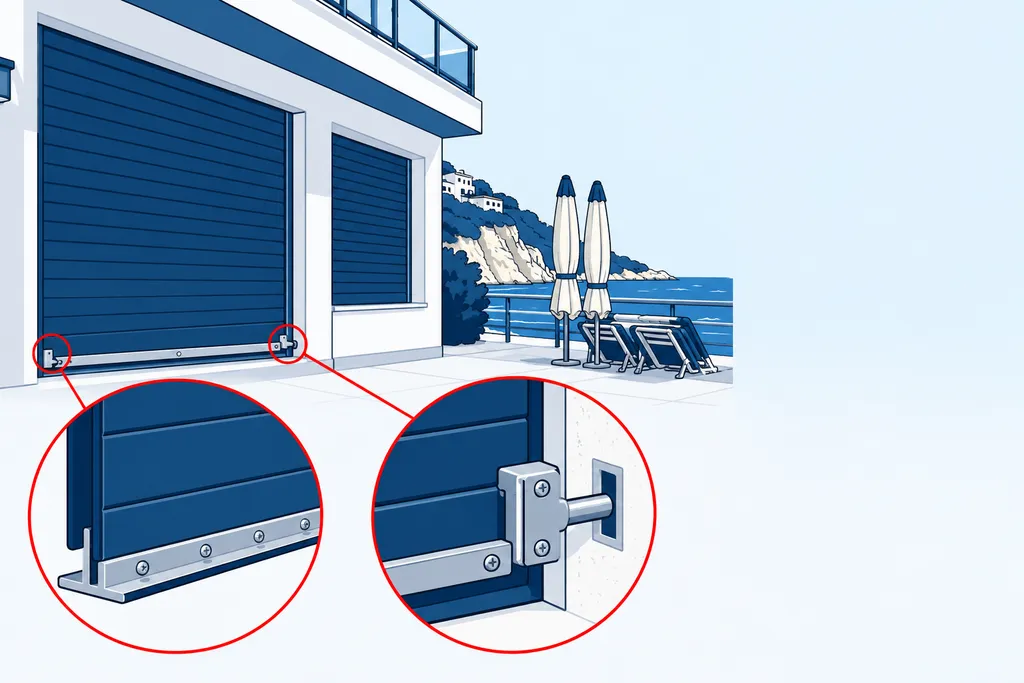
The coast around Torrevieja is full of houses that are used for a few months and closed for the rest of the year. Some belong to families from Madrid, Murcia or inland who come down in summer. Others belong to owners from northern Europe who spend the winter here and go back to their own country in spring. Many are let for a few weeks and then left on their own.
In every case the same thing happens: the house is left with the shutters down, with nobody inside, for a long time.
The problem with a closed-up house
An empty house has an enemy that a lived-in house does not: time. Whoever wants to get in can come back several nights, try without any hurry and work without anyone disturbing them. And if they manage to open a shutter, nobody notices until someone comes round to check or until the owner returns.
What is more, shutters that stay down all day for weeks are a very visible sign that nobody is living there at that moment. It cannot be avoided: lowering them is the sensible thing to protect the house from the sun and the dust. What can be done is to make those lowered shutters hard to open.
What the reinforcement brings to an empty house
In a lived-in house, someone hears a noise, looks out, switches on a light. In an empty house there is nobody to react, so the shutter has to hold out by itself.
The T-profile reinforcement is designed for exactly that. The 4 mm steel profile fixed to the bottom slat means that slat cannot be bent, and the bolts at both ends, slotted into the wall, stop it from being lifted. With the house closed and the shutters down, every window becomes much harder to open from outside. We always put it like this: we reinforce roller shutters so they cannot be lifted or bent.
Squatters and empty houses
It is a real concern on the coast and we understand it. A house that stays closed for months and can be entered through a window is more vulnerable. Reinforcing the shutters helps to close off one of the ways in, but it is not the only one: the front door, the patio door and the cylinder count just as much. On the squatter protection page you have everything we check in a home that is going to be left on its own.
If you live outside Spain
You do not need to be here to get started. You can message us on WhatsApp in your language and send us photos of the shutters. If you are in your own country, ask whoever looks after the house, a neighbour you trust or the company that manages your holiday let to take the photos. What we want to see:
- Each shutter lowered, in full, from outside.
- The bottom part, where the last slat touches the windowsill or the floor.
- The sides, where the shutter meets the wall.
With that we tell you which shutters can be reinforced and give you a fixed quote before we start. You can pay by card, Bizum or cash. If you have other questions typical of someone who lives abroad, there is the foreign residents page.
Before closing the house for a season
A few habits that help, whether you have the reinforcement or not:
- Check that every shutter comes all the way down and that none is left halfway.
- Check the windows and patio doors one by one, not just the front door.
- Leave a key with someone you trust who can call in now and then, and do not hide it in a flowerpot.
- Ask that person to let you know if they see a shutter raised, bent or out of place.
- If you have lost count of how many keys to the house are out there, think about changing the cylinder before you leave.
When to do it
The most practical thing is to reinforce the shutters while you are here, before closing the house for the season. If you have already left, message us anyway and we will work out with you how to do it.
There is more information about the rest of our services for houses that stand empty for long spells on the holiday homes page, and the full explanation of the system in shutter security.