


 Español
 Deutsch
 Français
 Nederlands
 Polski
 Русский
 Українська
 Norsk
 Svenska
 Suomi
 Italiano
 Dansk
 Čeština
 Português
 Română
 Български
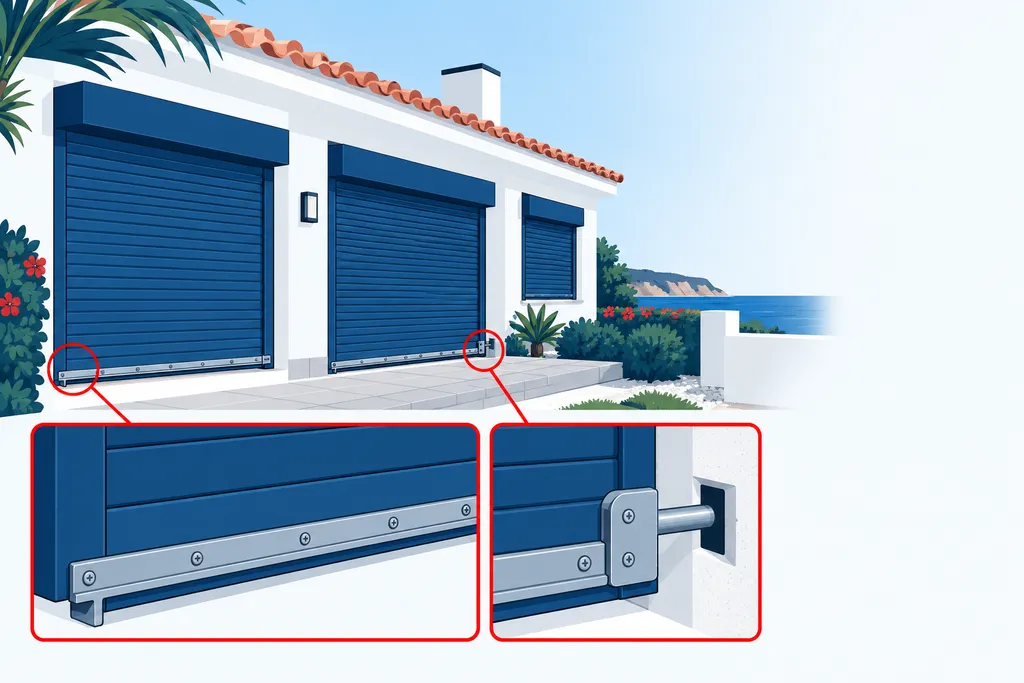
Anyone who lives on the ground floor knows it: the bedroom window looks onto the street, a garden or a patio, and from outside you can reach it standing up. In Torrevieja, in Orihuela Costa and across much of the Vega Baja this kind of home is the most normal thing in the world. Rows of bungalows, ground-floor flats with a garden on urbanisations with a communal pool, townhouses with a back patio, single-storey houses.
They are very pleasant homes for living near the sea, and they share a weak point: the shutters.
Why the shutter matters so much on a ground floor
In a flat high up, the shutter is a comfort. On a ground floor, it is part of the security of the house. There are several very specific reasons:
- It can be reached without a ladder. There is no need to climb or stand on anything. It is enough to be in front of the window.
- Many windows cannot be seen. Those that look onto the back patio, a side passage between two houses or a green area on the urbanisation are out of sight of the neighbours and the street.
- Hedges and walls hide things. What gives privacy in the garden also gives privacy to anyone who wants to get in.
- Communal areas are walkways. On many urbanisations anyone can stroll along the internal paths without attracting attention.
Summer, with the window open
The heat here is fierce and the habit is the same in almost every house: at night the window is opened and the shutter lowered to let the air through. The window is left wide open and the only thing separating the bedroom from the street is the shutter.
With an ordinary shutter, that is not much: the bottom slat can be lifted or bent from outside. With the T-profile reinforcement, the bottom slat has a steel profile fixed underneath that does not bend, and the bolts at its two ends slot into the wall. The window can stay open to let the cool air in, and the shutter becomes very hard to open from outside.
Short absences count too
You do not have to be away for months. A weekend with family, a week’s holiday or simply a long day at work leaves the ground-floor flat on its own. On a ground floor, during those hours, the lowered shutter is what acts as the door at each window.
Where to start on a ground floor
If you have several windows and want to go step by step, this is usually a sensible order:
- The windows that look onto the back patio or a side that cannot be seen from the street.
- The bedroom windows, above all if you sleep with the window open in summer.
- Those next to something someone could lean on or climb, such as a low wall or a garden table.
- The rest of the ground-floor windows.
Windows and patio doors with a shutter also come into the conversation: from the photo we tell you what we see in each one.
The shutter is not the only thing
On a ground floor, the front door and the patio door can also be reached easily. If you are going to reinforce the shutters, take the opportunity to look at the rest. An old or unprotected cylinder is as poor a starting point as a shutter without reinforcement. You have more information on security cylinders and, if you want a quick idea of how your door stands, you can take our security check.
How to ask for it
Take photos of the shutters that worry you, lowered and seen from outside, and of the sides where they meet the wall. Send them on WhatsApp, in your language if you prefer. We tell you whether they can be reinforced and give you a fixed quote before we start.
If you want to see first what the system is like inside, you have it on the main shutter security page. And if your ground-floor flat is your main home, the homes and private clients page has the rest of the things we do for homes like yours.