


 Español
 Deutsch
 Français
 Nederlands
 Polski
 Русский
 Українська
 Norsk
 Svenska
 Suomi
 Italiano
 Dansk
 Čeština
 Português
 Română
 Български
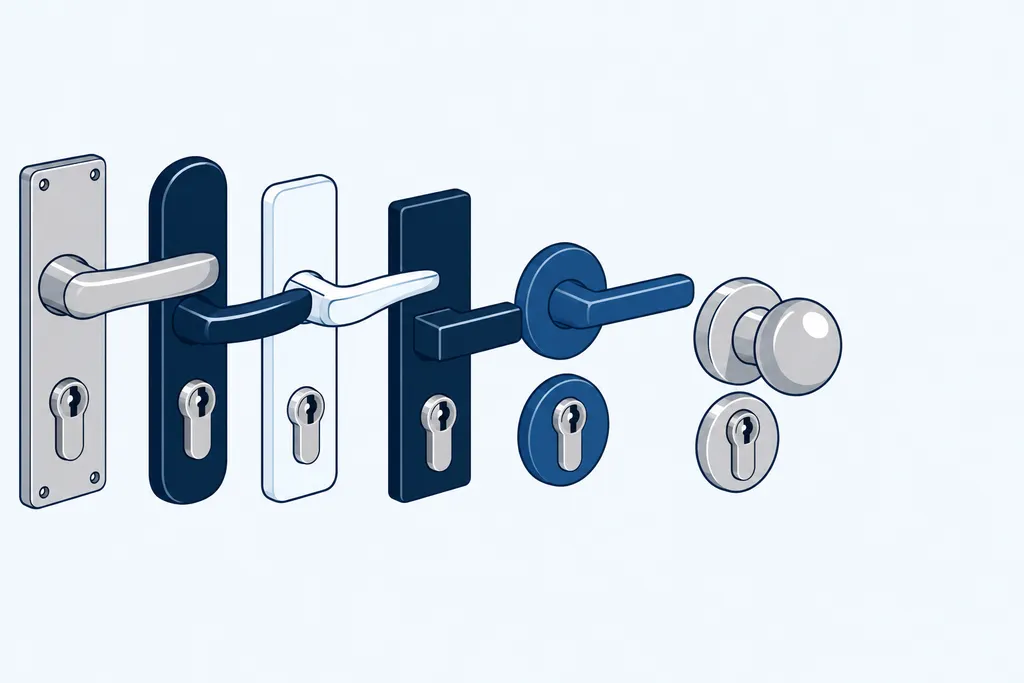
The handle is the first thing you touch when you come home and the most used part of the whole door. That is also why it is the first thing you notice when it fails: it droops, it has play, it squeaks or it turns without opening. The good news is that in most cases the handle is replaced and the lock is still fine.
Can handles be replaced without changing the lock?
Almost always, yes. The handle and the lock are joined by a square bar called the spindle, which goes through the door. As long as the new handle uses the same spindle and its screws go through the same holes, the lock is not touched.
There are two cases where the lock should be checked too:
- When the handle droops because the return spring in the lock has broken, not the one in the handle.
- When the handle turns but the latch does not move, because the broken part is the follower, which is inside the lock.
To find out, take off the handle and turn the spindle with a pair of pliers. If the latch goes in and out properly, the lock is sound.
Lever handle, knob or pull handle
Lever handle
The traditional lever. It works with little effort, you can open it with your elbow if your hands are full and it is the most comfortable for older people and children. It is the most practical option for almost every door in a house.
Knob
The ball or disc you turn by hand. It looks more classic, but it is harder to turn, especially with wet hands or little strength. On the front door a fixed knob is often used on the outside, which does not turn and is only for pulling, while the door is opened with the key.
Pull handle
A fixed grip with no mechanism. It is used on sliding doors, on cupboards and, fitted vertically, on some modern front doors.
Rose or backplate
Handles sit on a base that covers the hole in the door. It can be:
- A rose, a small round piece just for the handle, with a separate one for the keyhole.
- A backplate, a long piece that carries the handle and the keyhole or the privacy turn in the same piece.
If your door has a backplate and you want to change to roses, or the other way round, old marks or holes may be left on show. We tell you beforehand so there are no surprises.
What we measure
- The spindle, its thickness and its length, which depends on the thickness of the door.
- The distance between the handle and the key on backplates, so the holes line up.
- The thickness of the door leaf, so the through bolts tighten properly.
- The hand of the door, because some handles are reversible and others are not.
Front door handles
On the front door, the handle is a security matter. An outside handle that turns leaves the door depending on the latch, which can be opened with a simple card if you do not lock it with the key. That is why many front doors have a fixed knob outside and a handle inside. A security escutcheon around the key is also a good idea: it protects the lock cylinder and usually has its own pull handle. You will find it in escutcheon installation.
The coastal climate
In Torrevieja and along the Vega Baja coast, outside handles suffer from salt air. Poor quality ones pit, lose their colour and soon end up loose. For outside, terrace or patio doors we recommend good quality stainless steel or solid brass, and avoiding cheap painted or chrome-plated finishes. Indoors there is much more freedom.
In rental properties, especially holiday lets, it is best to choose sturdy handles that are easy to replace, because they get more use and less care.
Replacing handles and lock together
If, besides the handle, the lock on an interior door is failing, the practical thing is to change everything at once so it all matches. In interior door locks you have the options for bathrooms, bedrooms and sliding doors. If the handle does not spring back up because the lock is broken inside, that is a lock repair.
How we work
With a photo of the handle from both sides and another of the edge of the door, we can tell you whether replacing it is enough and which models fit. The quote is fixed before we start and the change is done on the same door, with no building work.