


 Español
 Deutsch
 Français
 Nederlands
 Polski
 Русский
 Українська
 Norsk
 Svenska
 Suomi
 Italiano
 Dansk
 Čeština
 Português
 Română
 Български
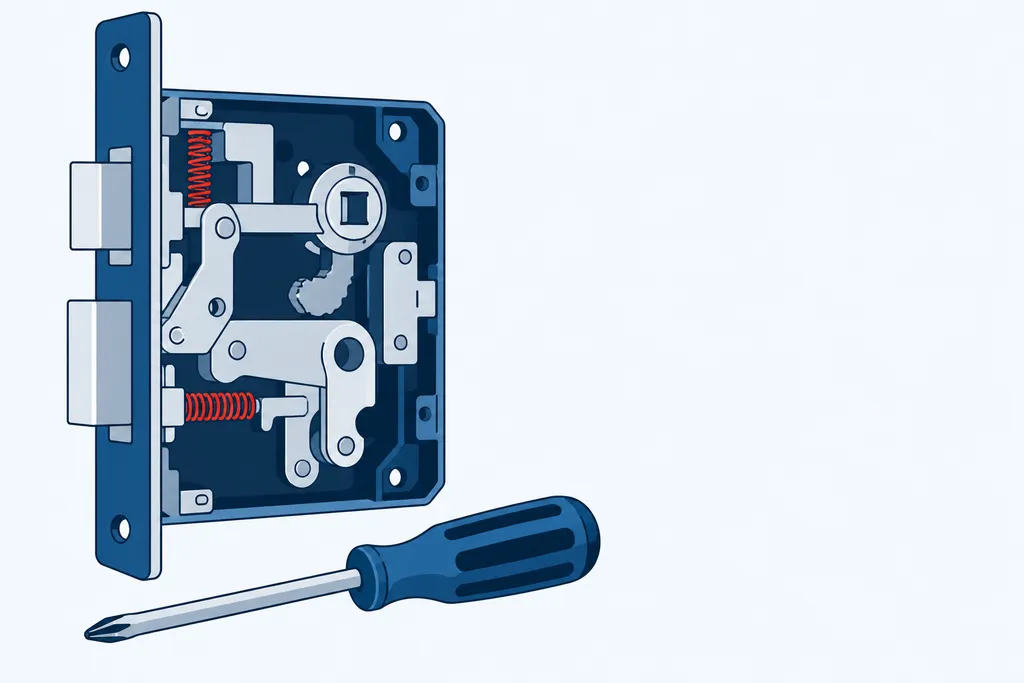
A lock rarely fails all of a sudden. It gives warning first: the key starts to get stiff, you have to push the door to lock it, the bolt makes a noise it did not make before. If it is checked in time, it can almost always be fixed without replacing anything expensive. If it is left, one day the key will not turn and you are locked out.
Symptoms and what is usually behind them
The key goes in but will not turn
It is usually the lock cylinder. It may be dirty, rusty or have worn pins. It also happens when the key is a badly made copy that has gradually worn down the mechanism. If it has just happened and you are at the door, have a look at the page the key will not turn, which explains what to do and what not to do.
Locking with the key is very stiff
Here the culprit is hardly ever the cylinder. Usually the door has dropped or the frame has moved, and the bolts rub against the strike plate as they come out. You force the key, the lock suffers and in the end something breaks. Sometimes adjusting the strike plate a few millimetres is enough; other times the door needs adjusting, which we explain in door repair and adjustment.
The latch will not come out or stays in
The latch spring has given out or there is dirt in the case. The door does not catch when you close it and blows open in the wind. It can often be fixed by cleaning and replacing the spring.
The handle droops or is loose
It may be the spindle that joins the two handles, the return spring or the through bolts. It is a simple fix, but it is best done before the handle stops moving the latch.
The lock is completely jammed
The key will not turn and the door will not open. Now we are talking about an emergency. There is more information in jammed lock.
Salt air, the enemy of coastal locks
In Torrevieja, Guardamar or Orihuela Costa the air carries salt. It gets into the cylinder, mixes with dust and forms a paste that seizes the pins. On terrace doors and in homes that stay shut for months the effect is much greater, because nobody works the lock in all that time.
What works:
- Working the lock from time to time, even if you are not going out.
- Cleaning the cylinder and lubricating it with a dry product, such as graphite or a lubricant made specifically for locks.
- Checking the outside locks when you open up the house for the season.
What does not work:
- Cooking oil or machine oil. It traps dust and salt and before long the lock is worse than before.
- General purpose spray oils squirted in. They help for a few days and then leave residue.
- Forcing the key with pliers. That is how keys snap inside.
Repair or replace: how we decide
We have no interest in replacing things for the sake of it. A repair is worth it when:
- The lock is good quality and the fault is in one particular part.
- The problem is alignment, dirt or lubrication.
- We can find the spare for the damaged part.
Replacing it is worth it when:
- The case is rusted inside or has broken cast parts.
- The repair would cost almost the same as a new lock.
- The lock was already weak on security and taking the chance to upgrade makes sense.
In that second case we explain the options in lock replacement. The decision is always yours, with both quotes in front of you.
What a repair involves
First we remove the cylinder and, if needed, the lock. We check the springs, bolts, latch and the cylinder cam. We also look at the door: hinges, gap to the frame and position of the strike plate. Many lock faults start with the door.
Then we clean, adjust or replace whatever is wrong, reassemble it and test it. We test with the door open, to see that the mechanism runs smoothly, and with the door closed, to see that the bolts go in without rubbing.
Rental homes and residential communities
In rented flats and communal entrances, locks suffer more because many people use them, and not all of them carefully. Regular maintenance prevents a lot of emergencies. If you manage several doors, tell us and we will organise it.
How to ask for it
Record a short video of the key turning or take a photo of the edge of the door and send it on WhatsApp. In your own language, if you prefer. We give you a fixed quote before we start and, if we find something else when we take it apart, we tell you before carrying on. We are available 24 hours and accept card, Bizum or cash.