


 Español
 Deutsch
 Français
 Nederlands
 Polski
 Русский
 Українська
 Norsk
 Svenska
 Suomi
 Italiano
 Dansk
 Čeština
 Português
 Română
 Български
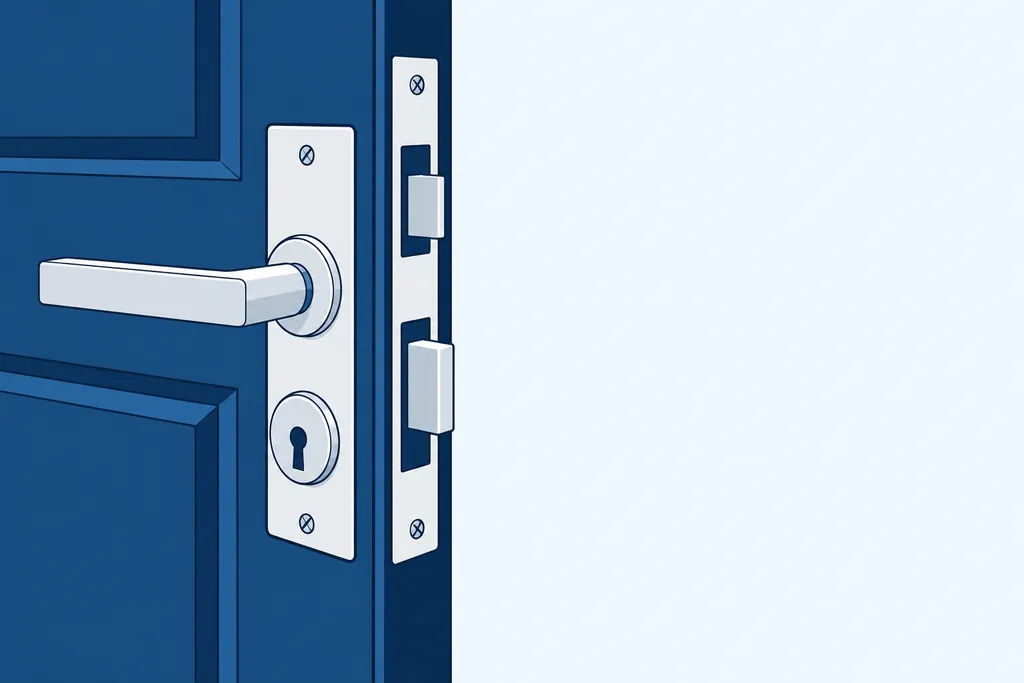
Installing a lock is not swapping one part for an identical one. It means putting a lock where there was none before, or where the existing one no longer does what you need. It happens a lot with wooden doors in older homes that only have a latch, in bungalows bought with the original lock, in storerooms converted into a studio or in shops that change use and need better locking.
In Torrevieja we have been fitting locks on all kinds of doors for 15 years. The first thing we always do is look at the door, because the best lock on the market is no use if the door leaf is flimsy or the frame moves.
Which type of lock suits you
Mortice or surface-mounted
A mortice lock sits inside the edge of the door. It looks neat, as only the faceplate and the cylinder are visible, and it is what almost every modern front door has. The door leaf needs to be thick enough to cut the pocket without weakening it.
A surface-mounted lock is screwed onto the inside face. It is a good option when the door is thin, when it is better not to hollow it out, or when you want to add a second locking point without touching the lock you already have. In many houses in the area it is fitted as extra security on the kitchen door or the door to the patio.
Single point or multipoint lock
A simple lock locks at a single point, level with the handle. For the front door of a home it usually falls short. If the door allows it, a lock that locks at the top, middle and bottom is well worth considering. We explain it in more detail in multipoint locks.
Euro profile for the cylinder
Almost all current locks have a recess for a euro profile cylinder. The advantage is that the day you lose your keys or want to step up, you change only the cylinder and not the whole lock. That is why, when we install a new lock, we also suggest a matching security cylinder.
The latch and the strike plate, the two forgotten parts
The latch is the tongue that clicks into place by itself when you pull the door shut. It is convenient, but if the door is left on the latch alone, without turning the key, it can be opened very easily. A new lock does not fix that habit: the door should always be locked with the key whenever you go out.
The strike plate is the part on the frame that receives the bolts. If it is screwed to a softwood frame with short screws, a hard shove pulls it out and the whole lock is useless. When installing, we fit a strike plate that matches the lock and fix it to the frame with long screws.
Coastal homes and their quirks
Here the salt air rules. Locks on outside doors, especially on the seafront or on doors opening onto open terraces, need a finish that stands up to salty damp. A lock with parts that rust ends up with a stiff bolt much sooner than you expect.
It is also common to find homes that stay shut for months. In that case the lock should be sturdy and the door should not rely on the latch. If the house is a second home, you can also see our page on security deadbolts, which are a very useful addition.
How we carry out the installation
We explain it without jargon:
- We measure the door. Thickness of the leaf, material, backset from the edge and condition of the hinges.
- We choose with you. We show you options that suit that door, not the most expensive one by default.
- We prepare the pocket. For a mortice lock the edge has to be cut out precisely so the lock case fits with no play.
- We fit the strike plate and the cylinder. Lined up with the bolts, so the locking does not rub.
- We test it several times. With the door open and closed, with the key from outside and inside.
If, when we open up the edge, we see that the wood is rotten or that the door has a structure we did not expect, we stop and tell you. We do not carry on until you agree.
Common mistakes we see
- Fitting a very good lock with a cheap cylinder that is easy to open.
- Leaving the cylinder sticking out of the door, which makes it easier to snap. That is what escutcheon installation is for.
- Installing on a door that has dropped without adjusting it first. The lock suffers and before long the key is hard to turn.
- Choosing by the look of the knob rather than the mechanism.
Shop and business doors
In a shop the lock is used many times a day and often by several people. There you need a mechanism that stands up to constant use and a cylinder that lets you control who has a key. If you have a shop in Torrevieja or the Vega Baja, tell us how you work and we will suggest something practical.
Before you call us
The quickest thing is to send us on WhatsApp a photo of the door from outside, another from inside and another of the edge with the door open. With that we give you a fixed quote before we start. We are available 24 hours, although a new installation is normally scheduled at a time that suits you. You can pay by card, Bizum or cash.