


 Español
 Deutsch
 Français
 Nederlands
 Polski
 Русский
 Українська
 Norsk
 Svenska
 Suomi
 Italiano
 Dansk
 Čeština
 Português
 Română
 Български
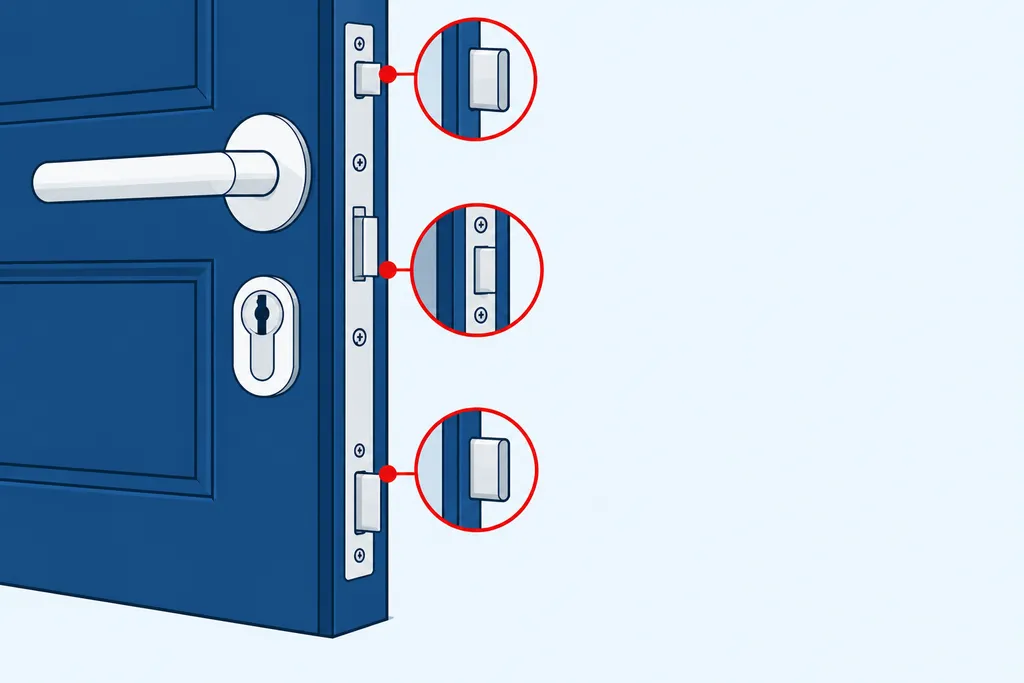
A multipoint lock is one that, when you turn the key, throws bolts at several points on the door at once. Most commonly it locks in the middle, at the top and at the bottom, although some models also throw side bolts spread along the edge. The idea is simple: if the door is held to the frame in several places, levering it at lock height is no longer enough to open it.
Where a multipoint lock makes sense
This type of lock is not just for security doors. We find it in many different situations:
- Front doors of homes, especially ground floor flats, bungalows and townhouses with direct access from the street or the garden.
- Security doors, which nearly always come with one built into the leaf from the factory.
- uPVC and aluminium doors, which use narrow faceplate locks with several hooks or rollers, and in many cases lock when you lift the handle.
- Shops and offices with a timber door onto the street that spends nights and weekends unattended.
On an interior door or a community storeroom it is usually too much. There are simpler solutions there and we will tell you so.
Types we usually fit
Mortice
It sits inside the edge of the leaf, with a long faceplate and rods that run up and down inside the door. It is the neatest to look at and the most common on security doors.
Surface mounted
It is screwed to the inside face of the door and throws bars upwards, downwards and to the side. It is useful on solid timber doors that will not take a long mortice mechanism, or when you want to add locking points without changing the lock you already have.
For uPVC and aluminium profiles
They have a narrow faceplate that fits the chamber of the profile. They lock with hooks, bolts or rollers that grip keeps spread along the frame. Their weak point is usually the cylinder, which should be a security one.
What fails most and why
Most of the faults we see on multipoint locks are not in the lock, they are in the door. When a door drops a couple of millimetres, the top or bottom bolts no longer go cleanly into their keep and start to rub. The key gets stiff, you have to push or pull the door for it to turn, and in the end someone forces it and an internal part breaks.
Signs that something is wrong:
- You have to push the door with your shoulder for the key to turn.
- The handle on a uPVC door is very hard to lift.
- One of the bolts only comes out halfway or leaves marks on the frame.
- You hear a metallic click when locking that was not there before.
If it happens to you, do not keep forcing the key. What is an adjustment today could tomorrow be a lock jammed with the door shut. In many cases it is fixed with a proper door repair and adjustment and by repositioning the keeps.
Salt air and houses shut up for months
On the coast, salty air gets in through the edge of the door and rusts the rods and internal springs. In homes that are only opened in summer or for certain seasons, the lock goes months without moving and seizes up. When the owner arrives, the key will not turn, or it turns and the bolts do not come out.
To avoid it:
- Lock and unlock all the points with the key at least once every time you go to the house.
- Use a dry lubricant or one made for locks, never thick oil.
- If someone looks after the house while you are away, ask them to do the same.
Replace or repair
When a particular part has broken and the model has spares, we repair it. When the lock is very old, badly rusted or no longer made, the sensible thing is to replace it completely. So that the new one fits without rebuilding the door, we measure the faceplate, the distance between the handle and the cylinder, the backset from the edge and the position of each locking point. With those measurements we look for a model that uses the same recesses.
If you change the lock, take the chance to check the cylinder. A multipoint lock with a basic cylinder leaves the security half done, and with a security lock cylinder well protected by an escutcheon the door is far more complete.
How we work
We ask for photos before we go so we bring the right part or at least know what to look for. The quote is fixed before we start. If, when we take it apart, we see something we did not expect needs changing, we show it to you and you decide. We work 24 hours a day, every day, in Torrevieja and the Vega Baja, and if your door is aluminium or uPVC you will also find our page on aluminium and uPVC locks useful.