


 Español
 Deutsch
 Français
 Nederlands
 Polski
 Русский
 Українська
 Norsk
 Svenska
 Suomi
 Italiano
 Dansk
 Čeština
 Português
 Română
 Български
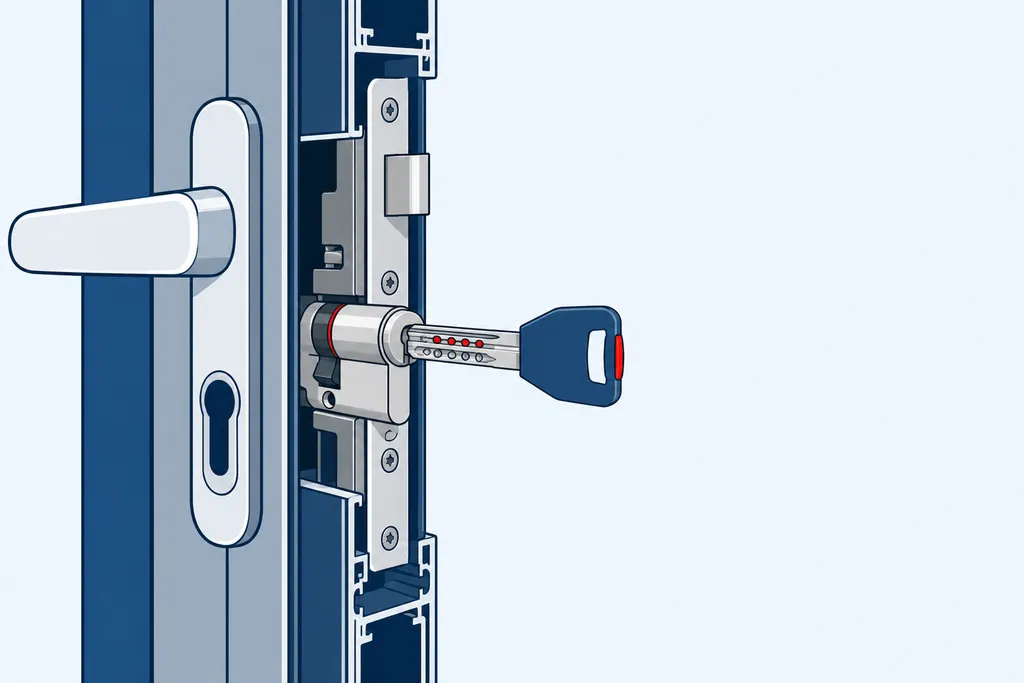
In Torrevieja and the Vega Baja there are a huge number of aluminium and uPVC doors. They are the terrace doors of almost every flat, the sliding doors onto the garden in bungalows and, on many urbanisations, the front door of the home as well. They all have something in common: they take locks designed for narrow profiles, which have nothing to do with those on a timber door.
We take care of replacing them when they break, repairing them when they jam and upgrading them when the door falls short on security.
Each type of door, its own lock
Sliding doors
They lock with a hook that comes out of the edge of the leaf and catches on the frame. When the hook does not grip, the door looks shut without really being locked, and from outside it opens by pushing or lifting the leaf. On terrace sliding doors at street or garden level that is a serious problem.
Hinged terrace doors
They have a narrow faceplate lock, sometimes with several locking points that engage when the handle is pushed down or lifted up. If the leaf goes out of adjustment, the handle becomes stiff or does not reach its position.
Aluminium or uPVC front doors
They usually have a lock with a euro cylinder and, on the better ones, several hooks or bolts spread along the edge. They can be quite secure doors if the lock and the cylinder are up to the job. When the lock secures at several points, the work is similar to a timber multipoint lock, with parts specific to the profile.
Can a security lock be fitted on an aluminium door?
Yes, within what the profile allows. A thick security door lock cannot be put into an aluminium chamber, but several things can be done:
- Replace the cylinder with a security cylinder of exactly the right size, which does not stick out and better resists bumping and picking.
- Replace a single point lock with a multipoint one that uses the same recess.
- Add extra locks on sliding doors, which stop the leaf being lifted or slid from outside.
- Replace worn keeps with new ones properly screwed to the frame.
What we do not do is drill or cut the profile any old how. A weakened profile loses stiffness and the door starts failing somewhere else.
What we see most on the coast
Salt air is the great enemy of these locks. The internal parts are small and thin, and rust gradually locks them up. On top of that, sand from the beach and the garden gets into the tracks of sliding doors and into the keeps.
The most common warning signs are:
- The terrace door handle will not go fully down or up.
- The key turns but the door will not open.
- The sliding door closes but the hook does not catch.
- The leaf has dropped and rubs at the bottom.
If your terrace door has jammed, in jammed terrace door we tell you what to do and what not to do while we are on our way. The main thing: do not force the handle, because in these locks the part that breaks is usually the internal one and that makes the repair harder.
Simple maintenance
To make the lock last:
- Clean the sand out of the tracks and keeps with a brush or a vacuum cleaner.
- Use a dry or spray lubricant made for locks, never cooking oil.
- If the house is going to be shut up for months, leave the door properly locked and work the handle again when you arrive, several times and gently.
The doors we do not touch
We work on the lock, the locking points and the adjustment of the leaf. We do not make or replace aluminium or uPVC joinery, nor do we touch motors. If the door is badly damaged and needs replacing, we tell you so you can go to an aluminium joiner.
How we work
The quickest way is to send us photos on WhatsApp: with the edge of the leaf and the handle in view we can tell which part it is before we go. The quote is fixed before we start. We work in Torrevieja and the Vega Baja 24 hours a day. If you also want to strengthen the cylinder on that door, have a look at our security lock cylinders.