


 Español
 Deutsch
 Français
 Nederlands
 Polski
 Русский
 Українська
 Norsk
 Svenska
 Suomi
 Italiano
 Dansk
 Čeština
 Português
 Română
 Български
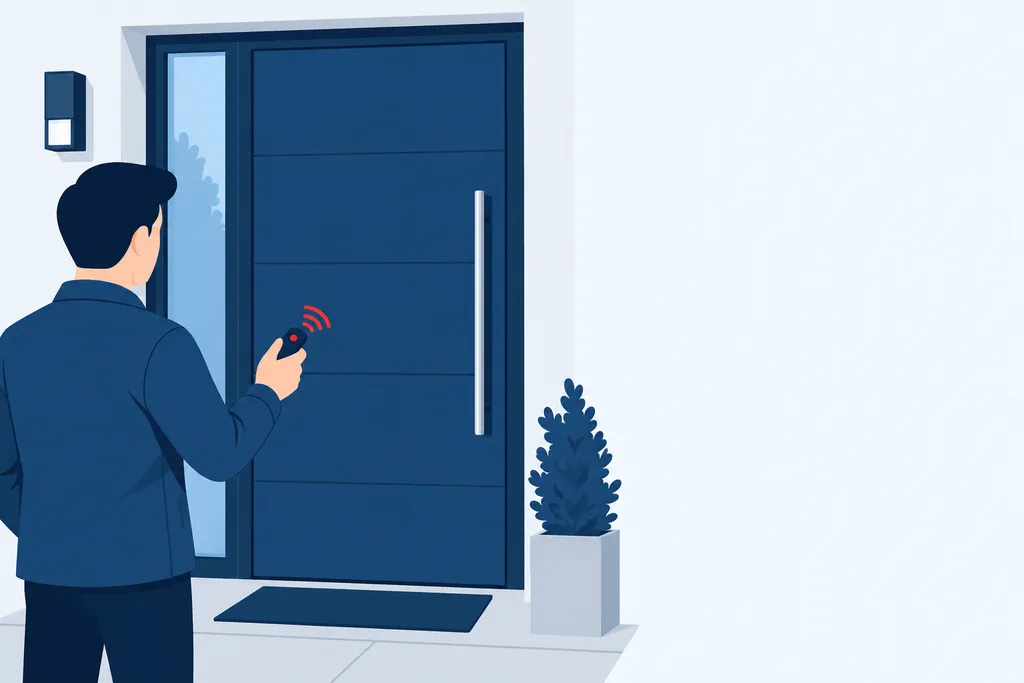
A hidden lock is a lock fitted on the inside face of the door that leaves nothing on show outside: no cylinder, no escutcheon, no keyhole. From the street the door looks the same as ever, with its main lock. Anyone who tries to force it finds that, after getting the main lock open, the door still will not move and they do not know why.
On this page we talk about mechanical hidden locks. The versions opened with a remote control or a mobile phone are electronic locks and we do not work with them.
What the advantages are
The point of a hidden lock lies in what cannot be seen:
- You cannot attack what is not there. With no cylinder outside there is nothing to snap, pull out or manipulate.
- It throws people off. Whoever forces the main lock wastes time looking for the second locking point, and time is exactly what they do not want to lose.
- It does not change the look of the door. In communities with rules about how doors look, or on old doors you want to keep, the outside face does not need touching.
- It adds one more locking point, usually well away from the main lock, which spreads the load if someone uses a crowbar.
When it suits and when it does not
As it has no access from outside, a mechanical hidden lock can only be locked and unlocked from inside. That determines what it is for.
It suits
- The front door, to lock it at night or when you are at home, as a back-up to the usual lock.
- Secondary doors you do not use to go out: the back patio door, the door from the garage into the house, the terrace door on the ground floor or a storeroom door.
- Shops with two entrances that are always locked from one of them.
- Bungalows and ground floor flats with a door straight onto the garden, which are the most exposed entrances to the house.
It does not suit
- The only door of a home that is left empty, because nobody could lock it on the way out.
- Emergency or evacuation doors in business premises, which must always open without complications.
- Homes where someone with reduced mobility lives who would find it hard to work one more lock.
If your house is left alone for months, as happens with many second homes on the coast, a hidden lock is useful on the secondary doors, and the front door is better protected with a good cylinder and an escutcheon. For windows and roller shutters, which is where most break-ins on ground floors happen, have a look at roller shutter reinforcement.
What we check before fitting it
A hidden lock is only as strong as what holds it. That is why, before recommending one, we check:
- The door leaf. On solid or security doors the lock grips well. On hollow interior doors it makes no sense.
- The frame. The keep has to be screwed into sound timber or into the wall. If the frame is loose, it is reinforced first.
- The free space. There has to be room for the lock without it hitting the handle, the main lock or the hinge.
- Everyday use. We place it at a comfortable height and on the side that feels natural to you, so you do not end up leaving it off out of laziness.
Mistakes worth avoiding
The most common mistake is fitting a hidden lock on a door that will not hold. If the door bends or the frame opens when someone uses a crowbar, it makes no difference how many locks it has. Another mistake is placing it where it can be seen through a pane of glass or a gap: it stops being hidden and loses its main advantage.
Nor does it make sense to trust everything to the hidden lock and leave the main lock with a weak cylinder. The reasonable approach is a balanced set: a main lock with a security lock cylinder, an escutcheon to protect it and, if you want an extra, the hidden lock.
Other ways to add a lock
If what you are after is a second lock that you can also open from outside with a key, what you need is a security deadbolt or a multipoint lock. We explain the differences with no obligation so you can choose what really suits your home.
How we do it
Send us photos of both sides of the door and of the frame, and tell us how you use it. With that we tell you whether it is worth it and give you a fixed quote before we start. If anything changes when we see the door in person, we explain it and do not carry on without your go-ahead.