


 Español
 Deutsch
 Français
 Nederlands
 Polski
 Русский
 Українська
 Norsk
 Svenska
 Suomi
 Italiano
 Dansk
 Čeština
 Português
 Română
 Български
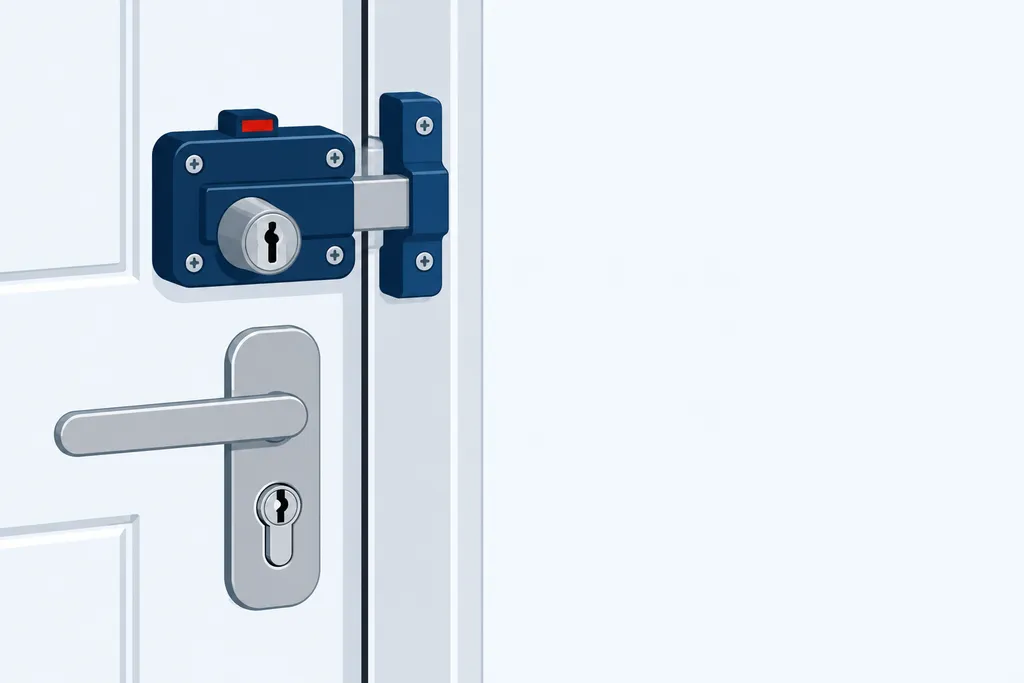
A security deadbolt is a second lock fitted on the inside face of the door, usually above the main lock. It has a thick bolt that goes into a steel keep screwed to the frame and is worked with a key from outside and with a key or a thumbturn from inside. Many people call it “the FAC bolt” after a very widespread brand; if that is the one you have, have a look at the page on FAC deadbolts.
What a second lock is for
A door with only one lock relies on a single point. If someone uses a crowbar, all the force goes to that point. With a deadbolt well spaced from the lock, the door is held at two different heights and whoever tries to force it has to beat both.
On top of that, the deadbolt usually has its own cylinder. If it has the same level of protection as the lock cylinder, anyone wanting to get in has to manipulate two different cylinders, with all the time and noise that involves.
Can a second lock be fitted on any door?
On most timber front doors, yes. What needs looking at is:
- The thickness of the leaf, so the cylinder passes through and is well protected.
- The free space on the inside, because the deadbolt cannot clash with the lock, the handle or a pane of glass.
- The frame. The keep has to be screwed into firm timber or, better still, reach the wall. A strong deadbolt on a weak frame gets ripped out whole.
- The type of door. It can be fitted on security doors, but it is often better to reinforce the lock they already have. On aluminium and uPVC there are other solutions, which you can see in aluminium and uPVC locks.
Types of deadbolt
Key operated on both sides
It locks and unlocks with a key both outside and inside. It is the most secure against someone who breaks a nearby pane of glass to reach in, but you need the key to hand to get out. In homes with children or elderly people it is worth thinking it through.
With a thumbturn inside
A key is used outside and a turning knob inside. It is the most convenient and the one most fitted in homes. If the door has glass near the deadbolt, we prefer the key operated type on both sides.
Long throw or bar bolts
They throw a longer bolt or a bar into the frame. They are useful on patio doors, storerooms and shops where the frame allows a deep fixing.
The same key for the lock and the deadbolt
A common drawback is having to carry two different keys. There is no need: the deadbolt cylinder and the lock cylinder can be keyed alike so they open with the same key. It is a job we often do along with the fitting, and you have it explained in keyed alike cylinders.
Where to place it
The height is no minor detail. If the deadbolt is very close to the lock, both locking points are in the same area and a crowbar beats them together. Normally it goes a good hand’s span above. On doors that open outwards, like many storerooms and pump rooms on urbanisations, the hinge side also needs watching.
In homes on the coast, we choose finishes that stand up to salt air, especially on the outside face of the cylinder, which takes the sea air all year round.
Typical mistakes we see
- Keeps with short screws that only grip the frame’s trim. They come off with a kick.
- Deadbolts fitted on hollow doors, where the leaf breaks before the deadbolt.
- Cylinders that stick out a long way on the outside and can be snapped with pliers.
- Deadbolts nobody uses because they were placed somewhere awkward or because the key is different from the lock key.
When something else is better
If what you want is to lock at several points with a single turn of the key, a multipoint lock may suit you better. If the door is very weak, a deadbolt will not save it and what is needed is door reinforcement or thinking about a security door. We will tell you clearly.
How we work
With a few photos of the door we give you a fixed quote before we start. We work in Torrevieja and all over the Vega Baja, 24 hours a day, and accept card, Bizum or cash. If something comes up during fitting that changes the job, we let you know before carrying on.