


 Español
 Deutsch
 Français
 Nederlands
 Polski
 Русский
 Українська
 Norsk
 Svenska
 Suomi
 Italiano
 Dansk
 Čeština
 Português
 Română
 Български
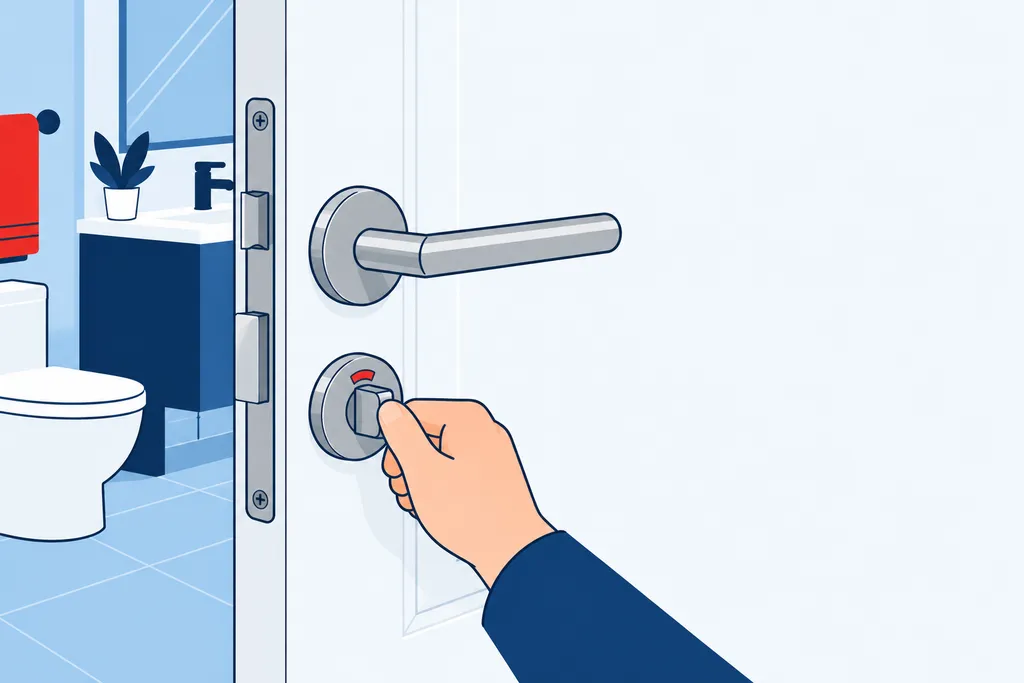
Locks on interior doors are not designed for security but for everyday life: so the door stays shut without slamming, the bathroom has privacy and, if a child locks themselves in, it can be opened from outside without breaking anything. When one of these things fails, the whole house notices.
Which lock each door takes
Passage doors
These are the doors to the living room, the kitchen or the hallway. They normally have a latch, which is just the part that goes into the frame and holds the door when it closes. They need neither a key nor a privacy lock. If the door swings open on its own in a draught, it is nearly always a worn latch or a strike plate that has moved.
Bathroom and toilet
A bathroom lock has a privacy bolt: a button or a small thumbturn on the inside that locks the handle. On the outside it has a release, a slot or an indicator that is turned with a coin or a simple tool. That release is important and we always check it, because it is what allows the door to be opened if someone is stuck inside and cannot get out.
Bedrooms
Here it depends on who sleeps in the room. In a children’s bedroom, the sensible choice is a latch or a privacy lock with a release, never a key. In a shared home or a flat let by the room, a lock with a key or even with a cylinder is sometimes requested. We explain which option suits each case and its pros and cons.
Sliding doors
Interior sliding doors, whether pocket doors set into the wall or hung on the outside, take special hook locks. They have a flush pull set into the edge and a privacy lock that hooks into the frame. They are delicate parts and easy to break if the door is pulled with the lock engaged.
Magnetic latch: quiet and with no latch to bang
An alternative that is asked for more and more is the magnetic interior lock. The latch stays hidden inside the lock and only comes out when the door closes and meets a magnet in the strike plate. It is quiet, does not rub on the frame when closing and looks very neat. It suits bedrooms and homes where peace and quiet matter. It is a mechanism with no batteries or connection.
Problems we fix
- The door will not stay shut, the latch does not go into the frame.
- The handle turns but does not draw back the latch.
- The bathroom privacy lock is stuck and cannot be opened from outside.
- The sliding door lock does not catch or the pull has come loose.
- The key to a room has been lost and the door is locked.
Often the lock is not to blame. A door that has dropped a little on its hinges leaves the latch at a different height from the strike plate. If that is your case, the fix involves door repair and adjustment and then, if needed, changing the lock.
If someone is locked in
A child in the bathroom, an elderly person who cannot turn the privacy lock or a room locked with a key from inside. If there is a risk to health, the first thing is 112. If there is not, try the outside release calmly. If it does not work, we help you open it without breaking the door. You have more guidance in person locked inside.
Choosing lock and handles together
Changing an interior lock is a good time to renew the handles, because the two parts work together. If the handle droops or has play, a new lock will not fix it. You can see options in handles and knobs.
What we look at so everything fits:
- The size of the faceplate and the distance from the edge of the door to the handle spindle.
- The thickness of the door.
- The side it opens towards.
- Whether the door is solid, hollow or glass.
In holiday rental homes
In homes let by the day the users change a lot and interior keys get lost easily. Many owners prefer to take the keys out of the bedrooms and leave only privacy locks with a release, so they do not have to open locked rooms in the middle of a stay. If you want a key on a particular room, for example one you keep for your own things, a cylinder lock can be fitted on that door.
How we do it
With a photo of the edge of the door we tell you which lock you have and what we suggest. The quote is fixed before we start and normally the job is done on the same door, with no building work and without changing the door leaf.