


 Español
 Deutsch
 Français
 Nederlands
 Polski
 Русский
 Українська
 Norsk
 Svenska
 Suomi
 Italiano
 Dansk
 Čeština
 Português
 Română
 Български
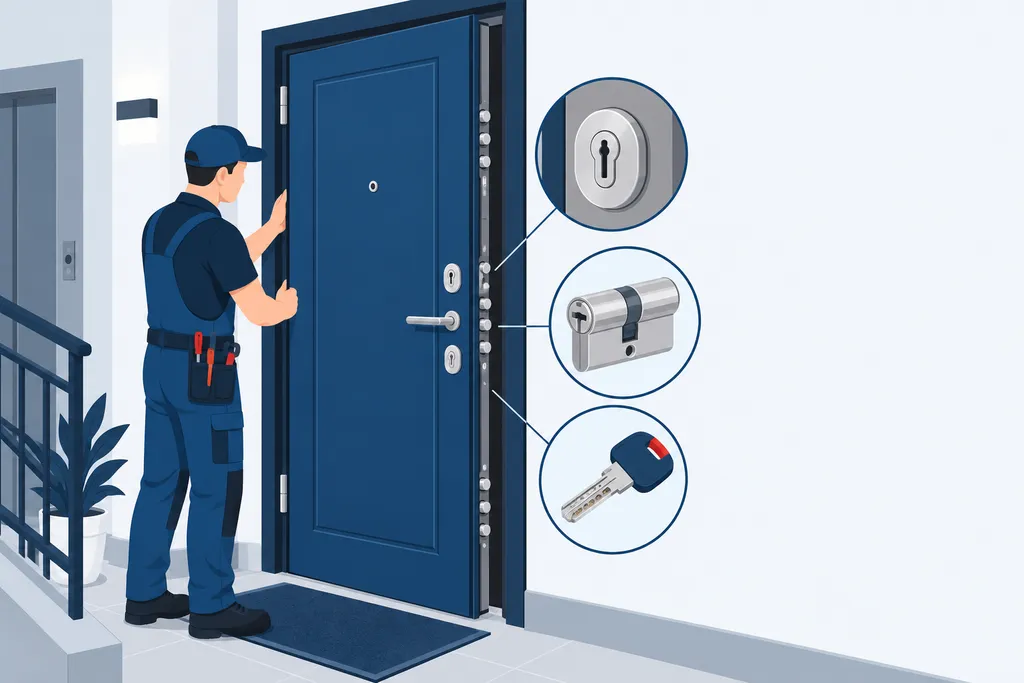
A security door is a wooden door, or one with a wood finish, with one or more steel sheets inside. It comes with a security lock, usually with several locking points, reinforced heavy-duty hinges and, in good installations, a metal subframe anchored to the wall. It is the most common front door in flats and new homes, and the one that makes most sense for most houses in the area.
We work with security doors in two ways: installing them and upgrading ones that are already fitted.
The difference between a security door and an armoured door
The question always comes up. A security door has a wooden leaf with a steel sheet inside. An armoured door has an all-steel structure, is heavier and needs different building work. We work with security doors and we do not sell armoured doors. For an ordinary home, a well chosen and well anchored security door gives very serious protection.
What to look for when choosing a security door
Not all security doors are the same. What really makes the difference:
- The subframe. It is the metal frame fixed to the masonry, to which everything else is screwed. If the subframe is weak or badly anchored, the whole door can be ripped out along with the frame.
- The inner sheet. How many sheets it has and how thick they are. A thin sheet bends under a crowbar.
- The lock. A euro cylinder is better than a double-bitted key, because if you lose a key you only need to change the cylinder.
- The cylinder and the escutcheon. The cylinder should be a security cylinder, exactly the right size so it does not stick out, and protected by an escutcheon that leaves nothing to grip.
- The hinges and the anti-jemmy bolts on the hinge side.
- The certified security grade. Ask for the door to come with its resistance certificate and check that the grade applies to the whole door, not just the lock.
The finish on the coast
In Torrevieja and along the Vega Baja coast you have to think about the climate. A door facing the outside gets strong sun and salty air all year round. Natural wood panels without protection crack and swell, and cheap fittings rust. For entrances facing the street, a patio or a garden, you want an exterior finish made for the elements and fittings that stand up to salt air. For doors opening onto an indoor communal landing, the options are wider.
The look of the building also has to be taken into account. In many buildings and urbanisations, doors facing communal areas have to keep a similar appearance. We go over it with you before deciding.
Upgrading the security door you already have
Many security doors from some years ago have a good leaf but have fallen behind on the parts that get attacked most. Without changing the door, a lot can be improved:
- Replacing the double-bitted key lock with a euro cylinder, when the lock model allows it. We can tell from a photo of the edge.
- Fitting a security cylinder that is anti-bump, anti-pick and anti-snap, with its escutcheon. You have the details in security cylinders and in escutcheon installation.
- Adjusting the hinges, because a security door is very heavy and drops a little over the years. When it drops, the lock starts to get stiff.
- Replacing the seals, the rubber strips that seal the door against the frame, so it closes without play and keeps out draughts and dust.
- Checking the subframe and anchoring it better if it moves.
Signs that your security door needs checking
- The key is hard to turn or you have to push the door to lock it.
- The door rubs at the bottom or on the frame.
- The top or bottom bolts do not go all the way in.
- The cylinder sticks out from the escutcheon or the door has no escutcheon.
- You notice the door moves in the frame when you push it while locked.
If you find any of these, a timely repair and adjustment stops the lock from eventually breaking with the door shut.
How we work
We always start by looking at the door or the opening, in person or from photos. We give you a fixed quote before we start, with everything to be fitted in writing. If something turns up when we take things apart that could not be seen, like a loose subframe or masonry in poor condition, we show you and do not carry on until you agree. Payment by card, Bizum or cash.