


 Español
 Deutsch
 Français
 Nederlands
 Polski
 Русский
 Українська
 Norsk
 Svenska
 Suomi
 Italiano
 Dansk
 Čeština
 Português
 Română
 Български
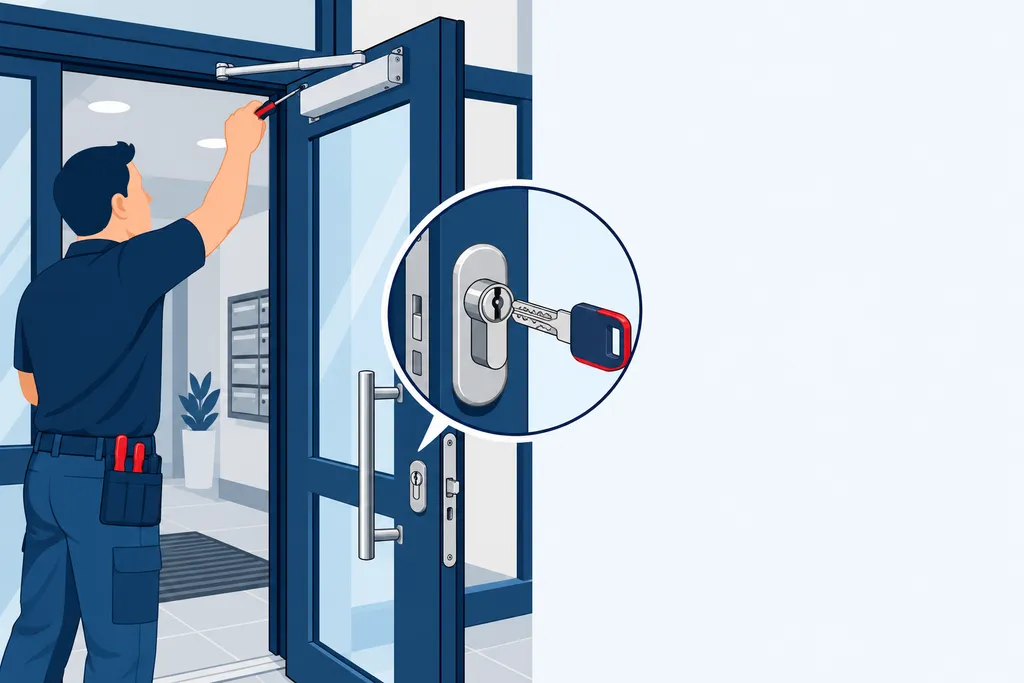
A door closer is the mechanism that makes a door close again by itself after it has been opened. The most common type is hydraulic: a box with oil and a spring, fitted at the top of the door and joined to the frame by an arm. When you open the door, the spring winds up; when you let go, the oil slows the closing so the door does not bang.
It looks like a minor part, but it decides whether an entrance door stays shut or is left open all night.
Where it is worth fitting one
- Communal entrance doors. This is where they belong. If the entrance door does not swing back by itself, someone ends up leaving it ajar and the building is left open.
- Access doors to shared garages and storerooms, where people go through with their hands full and forget to close them.
- Pool and communal area gates on urbanisations, which you want to be closed at all times.
- Shops and offices, so the front door is not left open to the wind or banging.
- Patio or garden doors in homes with children or pets.
Fire doors have to close by themselves
Many buildings have fire doors at the entrances to the garage, the stairs or the plant rooms. They are designed to stay closed and hold back smoke and fire, and for that they need their door closer working. A very common mistake is wedging them open. If the closing bothers you, what needs checking is the door closer adjustment, not blocking the door.
Types of door closer
Scissor arm
The traditional kind, with an elbow-shaped arm joining the box to the frame. It is sturdy, easy to adjust and suits most doors.
Slide arm
The arm runs along a straight track instead of folding. It looks neater and gets in the way less, which is why it is used in shops and offices.
Hold-open
It lets you leave the door open in one position when you need to, for example during a move or to air the place. It must not be used on fire doors, which have to close at all times.
The right strength
Each door closer has a strength designed for a certain door size and weight. If it is too weak, the door does not quite close, especially in the wind. If it is too strong, the door is hard to open and awkward for children and older people. On coastal entrance doors you also have to allow for the wind, which in some buildings pushes back against the door or shoves it as it closes. We choose the strength with all of that in mind.
Faults we fix
- The door slams shut. The speed or the final closing stretch needs adjusting. If it no longer responds to adjustment, the oil has gone.
- The door does not quite close and the latch does not engage. It may be the adjustment, the strength or a door that has dropped.
- Oil is leaking from the box. When a door closer loses oil it no longer slows the door and has to be replaced.
- The arm has come loose or has been bent by a knock.
- The door takes ages to close, especially in winter.
When the door does not close because it rubs or has dropped, the door closer is not to blame. First the door needs adjusting and then the door closer can be regulated.
Door closers and entrance security
An entrance door that closes by itself is a residential community’s first security measure. But if it does not catch when it closes, people still get in with a push. That is why we also check the strike plate and the lock on the entrance door. If the building has several communal doors, it may be worth having them all open with the same key through a master key system. For residents’ associations and property managers we also offer lock maintenance, which includes checking these mechanisms.
We do not work on electric door releases or video entry systems: if that is where the entrance door is failing, you need a technician for those systems.
How we work
Send us a photo of the door and, if it already has one, of the door closer and its arm. We tell you whether adjusting it is enough or it needs replacing, and give you a fixed quote before we start. We work for private owners, residents’ associations and businesses in Torrevieja and the Vega Baja.