


 Español
 Deutsch
 Français
 Nederlands
 Polski
 Русский
 Українська
 Norsk
 Svenska
 Suomi
 Italiano
 Dansk
 Čeština
 Português
 Română
 Български
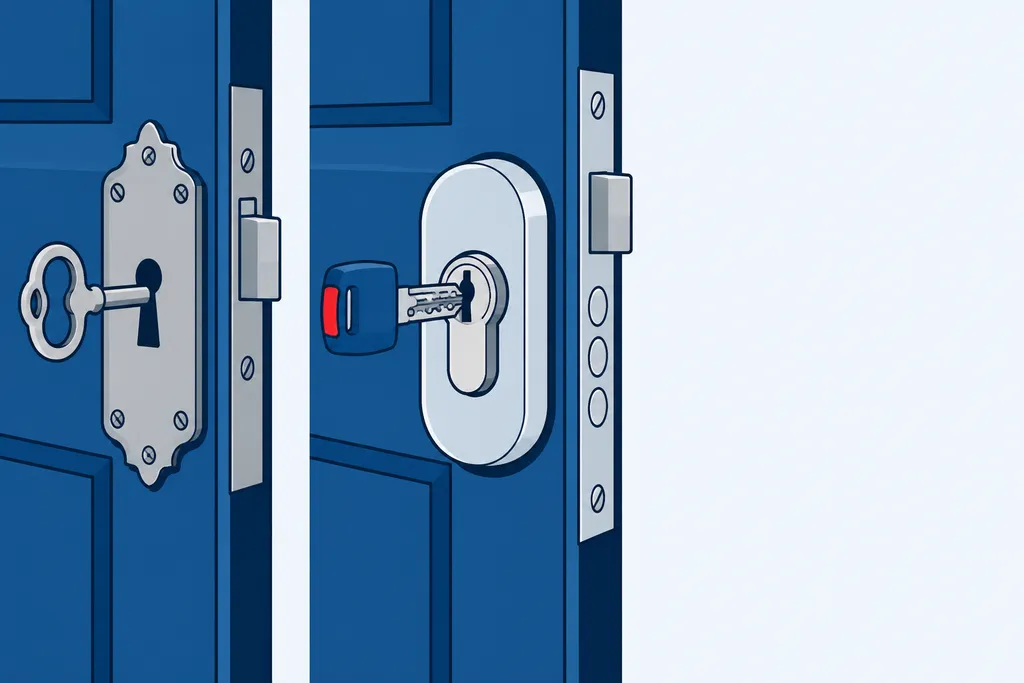
The lever lock is the traditional kind: a large key with a flat bit and cut teeth, which moves a set of small plates inside called levers. For decades it was the standard on front doors, patio doors and yard doors. Today it is still fitted in many older houses in the centre of Torrevieja, in country houses across the Vega Baja and on side doors that nobody has got round to updating.
If you still open your home with one of those keys, this service is for you: we remove the lever lock and fit a lock that works with a euro cylinder in its place.
Why it pays to move away from a lever lock
A simple lever lock has very few possible combinations. That means many different keys are so similar that they can open locks that are not theirs, and that it can be manipulated from outside with very basic tools, leaving hardly any trace. On top of that, the keyhole is large and shows the mechanism.
There are other everyday drawbacks too:
- Spare parts for older models are hard to find, and when something breaks inside it often cannot be repaired.
- The key is heavy, bends easily and wears down, and once it wears it starts to fail.
- If you lose a key, the only way to have peace of mind is to change the whole lock, because there is no cylinder to replace.
With a euro cylinder all of that changes. The day you lose a key or a tenant moves out, you only need to change the lock cylinder without touching the lock. And if you want more protection, you can fit an anti-bump or anti-pick cylinder and an escutcheon to cover it.
How to tell if your lock is a lever lock
You do not need to be a locksmith to recognise one. Look out for these clues:
- The key is long, with a round shaft and a flat bit at the end.
- The keyhole has the classic keyhole shape, round at the top with a slot underneath.
- From the inside, the lock is usually a metal box screwed to the face of the door, or it sits inside the wood with a faceplate on the edge.
If in doubt, send us a photo of the key next to a ruler or a coin and another of the edge of the door. That will settle it.
The two ways to do the conversion
Surface-mounted lock with cylinder
When the old lock is screwed onto the inside face of the door, the most practical option is usually to fit a surface-mounted euro cylinder lock in its place. Much of the existing work on the door can be reused and the result is sturdy. On old solid wood doors it is a very effective solution.
Mortice lock with cylinder
If the lever lock sits inside the door leaf, we remove it and fit a mortice cylinder lock. Sometimes the old opening can be used almost as it is, and sometimes it needs adjusting. What we never do is cut away more wood than necessary: a door weakened on the inside loses whatever the new lock gains.
In some cases the old keyhole is left visible on the outside face. We cover it with an escutcheon or a plate so there is no hole left for tools to get in.
What we check before suggesting a lock
Not every old door will take the same thing. Before giving you a quote we look at:
- The thickness and condition of the door leaf. A door with woodworm or split timber needs a different solution, and we will tell you so.
- The frame. If the strike plate does not grip into sound wood or masonry, the new lock is not much use. We reinforce it if needed.
- The opening side and the hand of the door, so the new lock fits without forcing.
- How the door is used. The front door is not the same as the back patio door or a storeroom door.
Local conditions
In houses near the sea, salt air eats old locks from the inside. Many of the lever locks we come across have levers seized with rust and a key you have to push in. If that is your case, do not use cooking oil or thick grease: it traps sand and makes things worse. The sensible thing is to change it before it jams with the door shut.
We also see plenty of inherited or newly bought houses in the Vega Baja that keep the original lock on the yard door or the old garage. These are doors that are rarely used and, for that very reason, get neglected. If you have several doors, we can fit cylinders that all open with the same key through keyed alike cylinders.
Worth knowing before we start
The change is done with the door in place and with no building work. We explain which lock we suggest and why, and the quote is fixed before we start. If something turns up when we remove the old lock that changes the job, rotten wood behind it for example, we stop, show you and do not carry on until you are happy.
If you also want to raise the security level from day one, ask us about security cylinders: they are fitted on the same visit and your new lock is protected from the start.